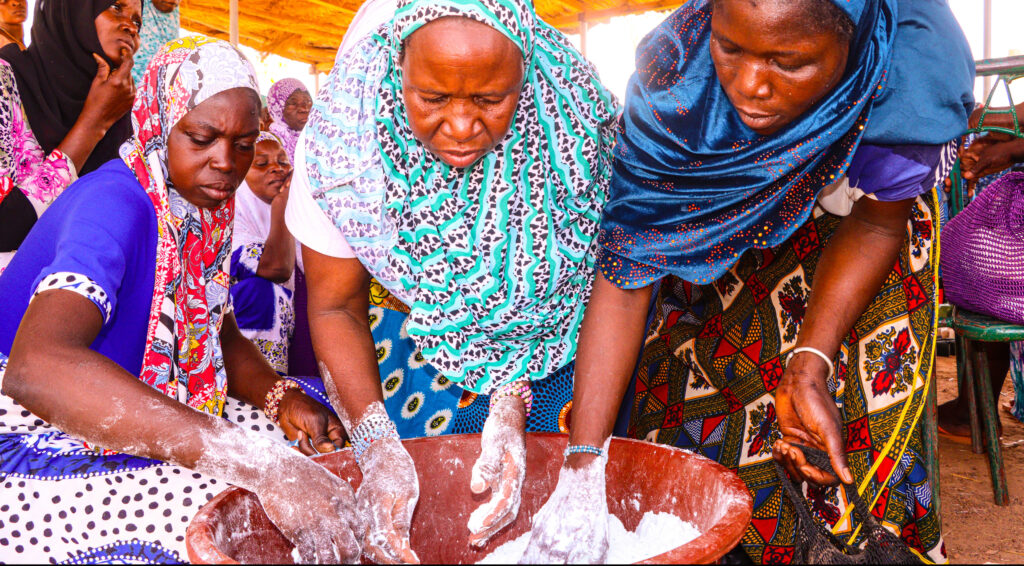
Population movements linked to the security crisis in Burkina Faso can generate tensions between host communities and internally displaced persons (IDPs). Fastenaktion’s partner organizations, such as the Association SOUGRI-NOOMA pour le Développement des Initiatives Féminines (ADIF), the Union des Groupements Producteurs Agroécologistes Kotisseké (UGPAKS), and the Associations pour la Sauvegarde des Masques Dédougou (ASAMA), address this challenge by developing various initiatives dedicated to peace and social cohesion.
Land Pressure and the Promotion of Community Solidarity
Tensions often stem from competition over access to natural resources such as land or water. To address this, Fastenaktion’s partner organizations implement diverse initiatives, such as collective fields or community grain storage based on shared labor, which help strengthen social bonds. These initiatives foster dialogue within and between communities and cultivate the idea of working together for the common good.
Moreover, integrating participatory and endogenous mechanisms in community conflict management — meaning practices and solutions developed by the communities themselves and rooted in their traditions — is essential. Examples include village councils, dialogue circles, theatre, and traditional mediation, all of which play a key role. Tailored to local realities, these community mechanisms offer a more informal and flexible approach to conflict resolution. In contrast, less inclusive formats such as conferences led by external experts have proven less effective.
During the implementation of these activities, Fastenaktion’s partner organizations have faced resistance stemming from the context, social perceptions, or collective trauma. These obstacles manifest as fear or distrust, reluctance from traditional or customary leaders, and sociocultural resistance to social mixing. While natural in a context of prolonged crisis, these forms of resistance can be transformed into levers for social change through listening and the involvement of respected local figures in finding solutions.
Evaluation and Impact of Social Cohesion Activities
Evaluating the impact of such activities on social cohesion requires a qualitative, patient, and context-sensitive approach, as changes are often gradual, relational, and invisible in the short term. Within our projects, some impacts are already visible, such as the gradual integration of displaced women into local associations to improve access to land, and a reduction in tensions between young people of different backgrounds during football matches or cultural events.
To strengthen buy-in and maximize the impact of social cohesion activities, it is crucial to involve local stakeholders from the very beginning of project design, create safe spaces for dialogue and exchange, and value endogenous mechanisms. Fastenaktion’s experience shows that excessive institutionalization should be avoided to preserve the flexibility and anchorage of such activities in the community.