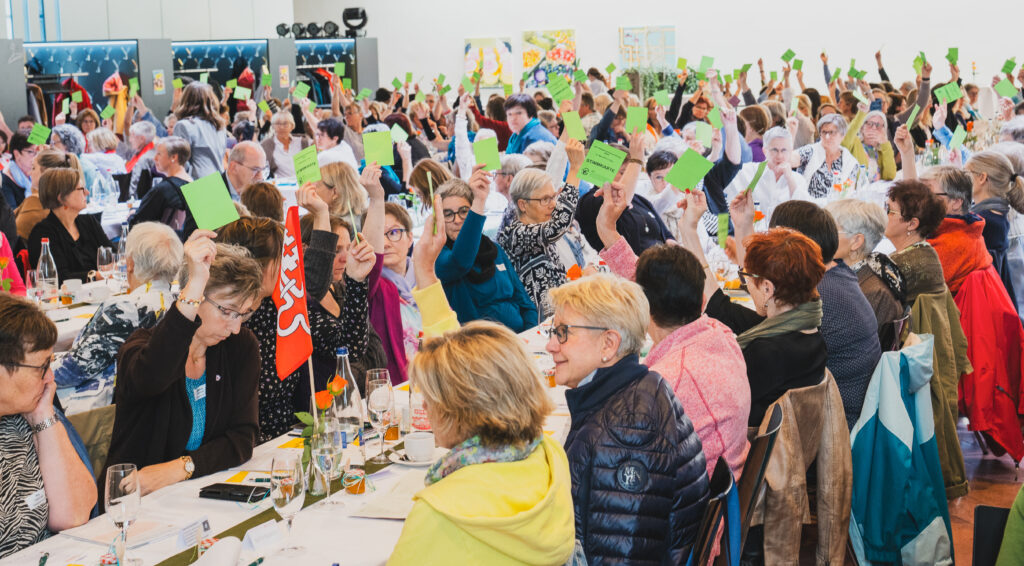
Associations are an integral part of Switzerland’s cultural landscape. Over 90,000 associations considerably shape social life, whether in sports, culture, neighborhoods, or churches. They create spaces where people can meet regardless of their origin, age, or social status or they bring people together who share a sense of belonging precisely because of their origin, age, or social status.
For decades, associations have served as a social glue, fostering peaceful coexistence. Today, however, they face new challenges. Social change along with major trends such as individualization and globalization bring new freedoms but also weakens familiar bonds. Concurrently, new forms of belonging and meaning must first be laboriously negotiated.
The Frauenbund Schweiz demonstrates how associations organized women’s networks that became spaces of self-empowerment. At a time when women did not have the right to vote, until 1971, women’s associations were one of the few opportunities for women to participate in civil society outside of the family. They organized reading circles, launched social initiatives, established continuing education programs, and made their voices heard in both church and political matters. Through these efforts, they made a significant contribution to social cohesion.
The historical experience of associations reminds us of the importance of collective structures in organizing solidarity, ensuring social participation, amplifying voices, and rendering the community tangible, both then and now. However, professional pressure, family responsibilities, and the desire for greater flexibility make long-term commitments less attractive. Younger generations are deterred by rigid structures, attendance requirements, and sometimes limited digital affinity among association boards. Competition from online communities adds to this issue. They enable rapid exchange, but the bonds formed are often less lasting. Overall, this creates a paradox: while there is a growing desire for community and meaning, many people lack the time or willingness to make long-term commitments.
Sociologist Hartmut Rosa uses the term “resonance” to describe a successful relationship with the world. Resonance occurs when people allow emotional connection, when they relate to and influence each other. In a society characterized by acceleration and individualization, these relationships enable experiences of closeness, commitment, and mutual recognition.
These effects are particularly evident in areas where traditional association work is at its strongest, such as visiting services for the elderly, family programs, aid campaigns for refugees, solidarity funds for mothers affected by poverty, and projects that strengthen community life.
The future of associations depends on their ability to adapt and evolve. They must create spaces for new forms of participation without compromising their proven substance.