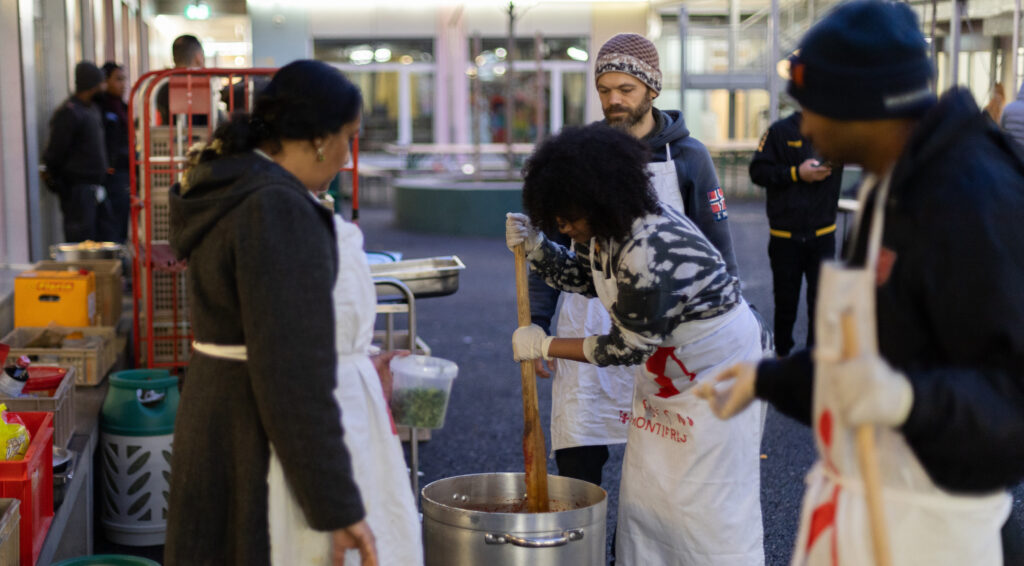
Social cohesion sometimes arises in the most unexpected places — like around the kitchen table, at the Federal Asylum Center in Zurich. Here, it doesn’t start with big programs, but with a simple invitation to cook. Together with people going through the asylum process, volunteers, and the team from Cuisine sans frontières (Csf), the kitchen produces more than just simple meals — it creates small pockets of participation, right in the middle of the uncertainty that comes with waiting for an asylum decision.
Since 2014, Cuisine sans frontières has been cooking in Zurich’s asylum centers — first at the Juch Test Center, then at Fogo in Altstetten. The project at the Federal Asylum Center Duttweiler was launched in 2023 with a clear mission: to give refugees, who often live in anonymous, temporary, and externally controlled conditions, a space they can actively shape where they can connect, share, and be seen.
In a context where so much is decided over their heads, cooking together becomes an act of empowerment. The idea is simple and effective: once a month, residents cook together. The ingredients reflect their countries of origin, fostering not just culinary exchange but also cultural identity and self-confidence. Language barriers barely matter when hands are busy chopping, spices are passed around, or onions are sliced. The meal that follows opens a space for connection — with other residents and with volunteers alike.
The focus here isn’t integration in the traditional sense; it’s about building relationships. It’s about creating a framework that allows trust to grow. Many participants experience loss of control, rejection, or isolation during the asylum process. In the kitchen, however, what counts is what they bring to the table: their knowledge, their stories, their flavors. It’s a rare moment of true equality and mutual recognition.
A remaining challenge is that the stays in these centers are often very short. Many people are there for only a few weeks before being transferred elsewhere. Success is therefore measured less by long-term bonds than by the quality of the experience in the moment: for some, it’s the first time in a long while that they truly feel welcome.
The project shows that social cohesion needs spaces of belonging; places where people can show up as themselves, with their history, their culture, and their recipes. Especially in Switzerland, where migration debates are often fueled by fear and exclusion, such spaces of encounter are essential.
Cooking at these centers isn’t a fix for the asylum system. But it’s a start. And maybe that’s precisely where its strength comes from.