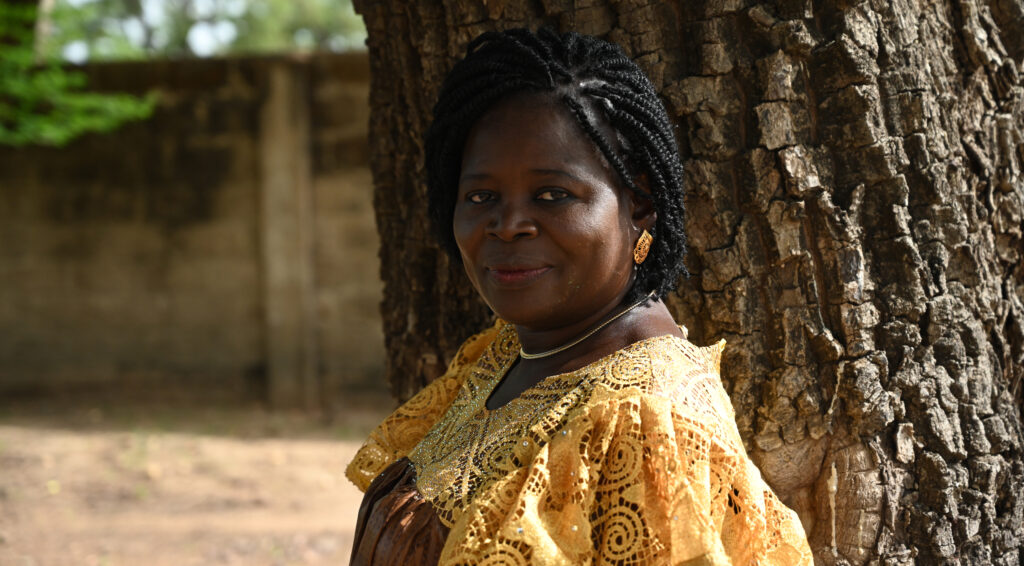
Elise Tama is the Executive Director of AFVA, a partner organization of Brücke Le Pont in northern Benin. There, extremist groups are gaining significant support, and attacks regularly occur in the project region. This makes the work of AFVA and Brücke Le Pont within the Karité Project challenging, but also crucial, especially for social cohesion. In this interview, Elise Tama explains why.
What is happening in northern Benin?
The root of the violence lies in the border areas with Burkina Faso and Niger, where armed groups are destabilizing the region. Several factors contribute to this situation. First, violence is increasing throughout the Sahel region. Additionally, tensions frequently arise between farmers and herders over access to natural resources. At the same time, high youth unemployment and a lack of prospects make young people particularly vulnerable to the influence of armed groups. These groups also impose levies on farmers. They foster fear, distrust, and tensions, while presenting themselves as protectors of the population. This context hinders our project, as increasing insecurity prevents access to certain rural areas.
What impact does this mistrust among the population have on your work?
Local communities live under constant threat from extremist groups. People fear being seen as collaborators with the government or NGOs, as they worry about reprisals from the extremists. As a result, they hesitate to express their opinions freely or participate in projects. This makes it difficult to obtain reliable information, which is essential for making well-informed decisions for the project. However, because we are well-rooted in the region through our network in local politics and consistent support for cooperatives within the project, we are still able to gather necessary information.
Northern Benin is poor even by national standards. How does this affect security?
Unemployment, poverty, and social exclusion are the fertile ground for radicalization. This is why our project is so important in this tense security context. By focusing on income generation, professional training—particularly for youth—and improving the livelihoods of vulnerable households, we significantly reduce the willingness to take up arms. Approximately 5,000 people directly benefit from the project, 3,600 of whom are women. Compared to 2021, project participants have more than doubled their income. Last year, one of the project cooperatives secured a major order: they will produce five tons of shea butter for the local school nutrition program. At the same time, the project also promotes social cohesion, as even stigmatized groups are included, encouraging exchange and interaction. I am mainly referring to the Fulani, a nomadic group, as well as refugees.
Which activities for social cohesion need to be implemented?
It will be important to further integrate the societal and participatory dimension into the project. People must actively contribute to resolving conflicts constructively. This also means giving local opinion leaders a key role in the project. Through the Karité Project, we aim not only to strengthen the socio-economic position of people, especially women, and support household income, but also to make an important contribution to curbing radicalization in the region.