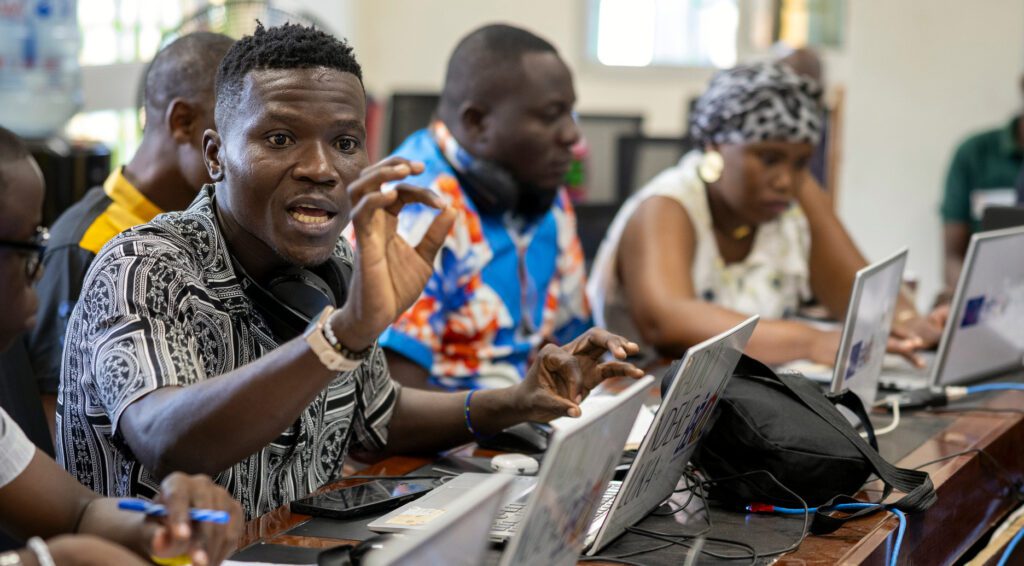
Social cohesion cannot simply be decreed. It requires shared spaces where communities can meet, listen to one another, and build common reference points. This is what the media make possible when they provide rigorous, inclusive, and responsible journalism. Strengthening social cohesion has been at the heart of Fondation Hirondelle’s mission for thirty years. The organization creates and supports independent media in conflict and crisis zones, convinced that access to reliable information is crucial for restoring trust, fostering dialogue, and laying the groundwork for coexistence.
This is exactly what Radio Ndeke Luka does in the Central African Republic. In a country scarred by community divisions, the radio station created by Fondation Hirondelle 25 years ago serves as a “neutral ground” where all voices can be heard. Every day, its journalists, like Theoneste Pounika (with his coverage of local sports news) provide the population with information that brings people together rather than divides them, and offer a platform to all components of society.
From Crisis Zones to Football Fields
This ability of the media to build bridges between communities in crisis is crucial in all contexts, far beyond conflict zones. In July 2025, during the Women’s Euro, seven African sports journalists spent a week in Switzerland. This immersion, supported by the Swiss Federal Department of Foreign Affairs, enabled them to meet with other institutions, newsrooms, and stakeholders in the fields of sport and human rights. They all share the conviction that when it explores the social dimensions of sport and goes beyond mere performance and results, sports journalism can strengthen social cohesion.
As Salamatou Kadri, journalist at Studio Kalangou (Niger), sums it up: “In Niger, sport in general, and football in particular, play a significant social role. It is a factor of cohesion, helping to reduce inequalities and strengthen the empowerment of women and youth.”
Lessons for Peace – and for Switzerland
Whether it is highlighting the unifying power of football or countering dangerous rumors, the core mission of journalism remains the same: to provide reliable information that ideally brings communities closer together. These experiences also show that without verified information, cohesion collapses under the weight of fear and rumor. From political pressure, disinformation, to limited resources, the challenges remain numerous, but they remind us that investing in independent media and in journalists’ ability to work rigorously contributes directly to social cohesion.
Switzerland, despite its strong institutions and democratic tradition, is not immune to social fractures and disinformation. Encouraging media literacy, promoting diversity of voices, supporting independent media, and strengthening trust in journalism are just as relevant here as they are in the Sahel or Central Africa. Strengthening social cohesion is not only about preventing violence: it is about reinforcing the very fabric of any democratic society.