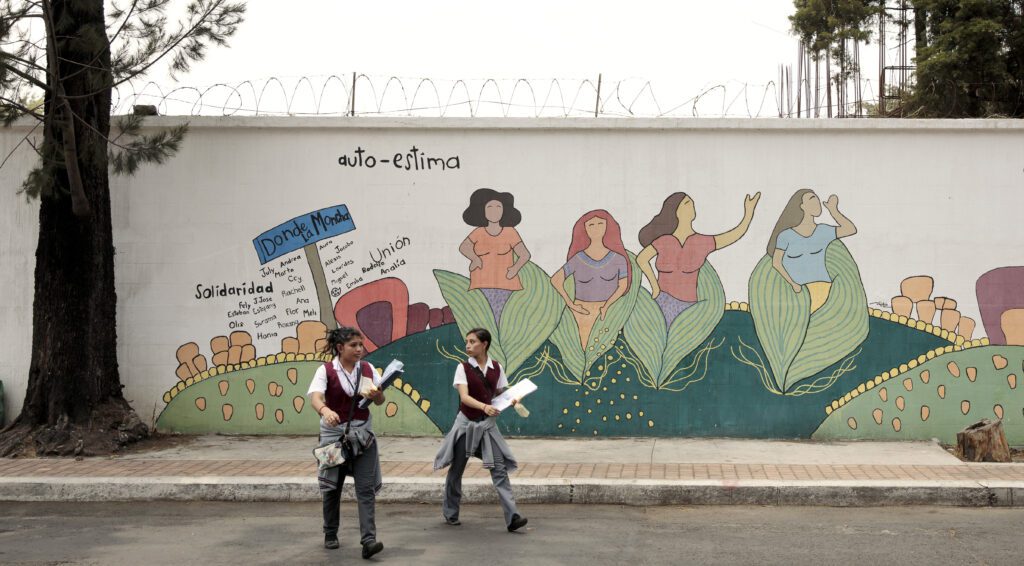
The history of Guatemala is marked by deep inequalities, discrimination, racism, exclusion, and internal wars, but also by the struggles of (Indigenous) peoples, in which women have played a very important role. During the civil war, which lasted more than 36 years and was “ended” with the signing of the peace agreements in 1996, thousands of women were physically and mentally tortured. They lost their children, their partners, their fathers, mothers, and sisters. Many of these women were raped, mutilated, or killed. To this day, the perpetrators in most of these cases have not received their just penalty.
After the signing of the peace agreement, the “development discourse” (the narrative of the government and the economic elite) in Guatemala further strengthened a neoliberal system. As a result, various transnational corporations entered the country to implement mega-extractive projects, expand monocultures, privatize basic services, and more. In contrast to the promise of “development” for all, money is prioritized at the expense of life. And it is the women who suffer the most under the current social, political, and economic conditions in Guatemala.
Most women are excluded from education from an early age, given that they must undertake the housework and, in many cases, work in the fields. The resulting illiteracy impacts their health, employment opportunities, the ability to know and defend their rights, access to information, and participation in social and political life.
In daily life, the hoped-for “development” seems like an illusion for many. Every day, numerous people emigrate to the USA to earn an income and ensure their families’ survival. In many communities, women and children are left behind, as men must emigrate. They are now directly confronted with the expanding extractive megaprojects plundering natural resources.
Despite the great adversities and limitations that women in Guatemala have faced and continue to face, they have fought and taken on various roles in the family, the community, and society in general. Since 2012, women have been a cornerstone in CODECA’s (Comité de Desarrollo Campesino) fight for structural changes to reach the “Buen Vivir” in Guatemala. Every day, they reach more women in the communities and in the streets, train them, raise awareness of the situation of women, and promote broad participation to advance the popular and plurinational constitutional process to build a plurinational state in Guatemala, moving toward the “Buen Vivir” as a shared vision. Fastenaktion supports the women’s movement of CODECA within the framework of the Guatemala country program.