The development and humanitarian sectors are at a crossroads. For decades, a North-to-South model has dominated, yet achieving sustainable development goals remains elusive. This stagnation persists because local civil societies have been historically excluded from design and decision-making, while simultaneously facing shrinking civic space. High-level commitments such as the Accra Agenda for Action and the Grand Bargain promised a paradigm shift, but the translation of these promises into reality remains largely unfulfilled and arguably backsliding.
Locally Led Development (LLD) is not new. It is a longstanding and fundamental good practice, based on good governance, that promotes the inclusion and participation of local actors. It promotes the redistribution of power and resources to end cycles of inequality, injustice, and fragility for efficient sustainable development. When combined, Locally Led Development and Good Governance enhance the creation of more inclusive systems. However, moving beyond mere rhetoric and preventing LLD from becoming just another trend requires confronting the inherent truths, egos, and insecurities associated with the redistribution of capacities, resources, and power.
Real Expertise and Perceived Risk
A primary barrier to LLD is the international sector’s perception of risk. Donors and international agencies often label local actors and organizations, as well as informal and non-traditional structures, as risky, which perpetuates a gatekeeping and dependency mentality and approach. The parachuting in of international consultants who are introduced as ‘the experts’, or the imposition of an international agenda or organization to act as lead contractor, are common approaches that position local actors as passive “beneficiaries” and ignore their contextual intelligence and experience. The latter translates to invaluable but often underestimated expertise in their contexts, which are impacted by international development and humanitarian aid, the effects of which they must ultimately live with—for better or worse. It also arrogantly assumes that not only do we know best, but that only we care about the well-being of the people and societies we work and engage with. This implies that without our involvement, resources would be mismanaged, strategies poorly planned, interventions improperly implemented, and positive impact would be unachieved.
True LLD requires addressing and countering double and contradictory standards. While donor instruments and rules necessitate a major overhaul, international organizations’ approaches require significant adjustments. Both involve recalibrating our egos and notion of risk, valuing the expertise of our national/local counterparts, and accepting self-questioning and our own change, not only that of others. Without a more enabling environment, Locally Led Development will be another passing trend and an unachievable sustainable development goal.
From Theory to Practice: Two Narratives of Change
Various Helvetas projects exemplify how this shift can and does function.
1. From “Building” to “Sharing” Capacity
The debate around “Decolonizing Aid” emphasizes that knowledge should not only flow from the North to the South. We must evolve from “capacity building”—a term that implies an inherent deficit in local actors—to capacity sharing. This approach fosters a reciprocal relationship among equals that values complementary expertise. In 2010, HELVETAS supported the establishment of a local NGO resource center in Lao PDR. Among various services offered, a capacity development program was included. What set this initiative apart was that the platform served as an open and transparent channel for local and International NGOs to seek services and support from one another. Donors and other institutions could also access and request services. This not only valued local NGOs as experts and development actors in their own right but also provided them with core funding for their organizations as part of a more independent and sustainable ‘business model’. The resource center and platform continue to operate today, in a country ranked by CIVICUS as ‘closed’.
Another poignant example is the CSO-PVE project. In Bangladesh and Sri Lanka, youth face challenges such as unemployment and limited opportunities for social & political engagement, which leaves a fertile ground for the recruitment of youth by extremist groups.
In this context, Helvetas facilitated peer exchange and cooperation between CSO actors from Bangladesh and Sri Lanka. Helvetas supported civil society groups and local communities to work with youth in and between the two countries to prevent and respond to violent extremism. Helvetas also promoted collaboration between these CSOs and local authorities, as well as with traditional and faith-based leaders. This direct interaction enabled a sense of dignity, mutual respect, and shared purpose. It broke down stereotypes, biased norms, and barriers to local innovation, peer cooperation, and locally led development. Acting as convener and facilitator, HELVETAS helped connect local actors across social, religious, and sectoral divides, allowing them to learn from one another and gradually build trust, social capital, and political capital for change. Ultimately, it fostered intercultural exchange and solidarity within and across borders, promoting greater social cohesion and peace.
2. From Implementation to Facilitation and Institutionalization
In Ethiopia, the transition from the Amhara Local Governance Project (ALGP) to the expanded Ethiopia Local Governance Project (ELGP) illustrates the power of a “convening” role. The project aims to ensure that communities not only benefit from improved basic services but also play a pivotal role in the participatory planning, delivery, and governance of basic services.
Instead of implementing the project on behalf of local authorities and the communities they are mandated to represent and serve, HELVETAS acted as a facilitator, leveraging its legitimacy to bridge the gap between people and the state.
This was not a top-down instruction but a facilitation of space and channels to voice and be heard. Citizens began using platforms like Telegram to engage directly with officials, creating real-time transparency and exercising “pressure” for more systematic, accountable follow-up. By reaching 420 neighborhoods and engaging 35,000 citizens, the project allowed local actors to claim and safeguard their own civic space. By shifting its role from implementer to facilitator of the process, Helvetas’ intervention became more relevant and easier to replicate in new areas, as it was built on local trust and permanent structures rather than external mandates and transient interventions.
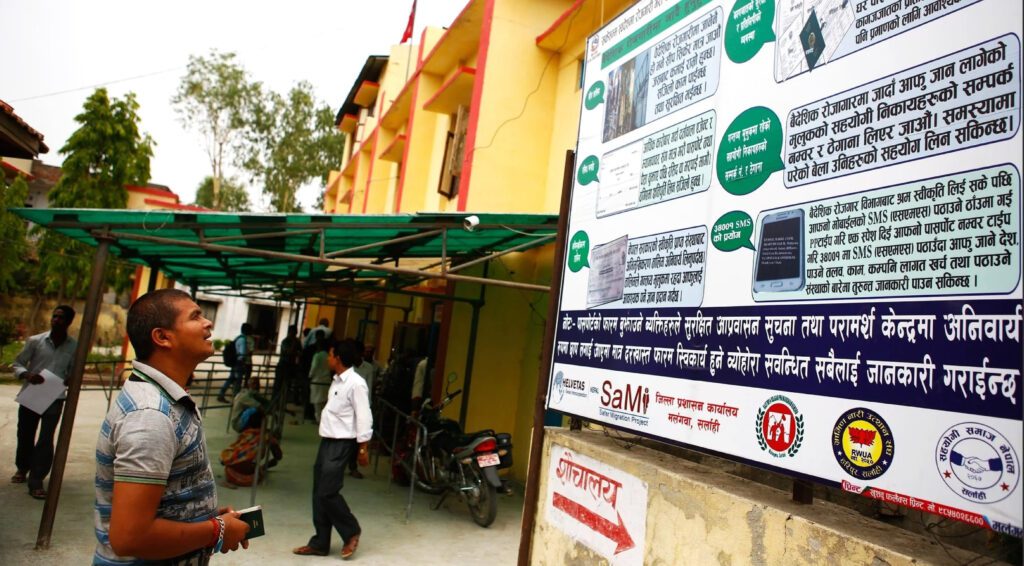
In Nepal, the SDC-supported Safer Migration (SaMi) project demonstrates the need to shift project ownership to achieve financial and operational sustainability. Helvetas supported 156 local governments to take full responsibility for migration service delivery. As a result, local partners transitioned from being project participants to primary stakeholders. They now contribute 70% of the project budget and oversee the quality of migrant-centered services.
This highlights a vital condition for meaningful and genuine LLD: the exit strategy. For local systems to become truly independent and accountable, international partners must be willing to step back. This approach provides the necessary space for local institutions to take ownership of their mandates and services in the long term.
Operationalizing Reality
The benefits of LLD will remain theoretical unless the aid architecture and the international cooperation archetype are reformed. This involves, among others:
- Organizational integrity and resilience: grant local organizations indirect core costs to invest in their own human resources management and development (HRMD), good governance, and long-term resilience.
- Sectoral and institutional legitimacy and pluralism: invest in and connect actors, organizations, and institutions across all sectors (non-state, public, and private). This strategy helps to address internal divides, bridge gaps, build connections, and enhance joint interest, will, capacities, and resources, ultimately leading to more inclusive and effective policies, budgets, and services.
- Results-Based Management: move away from short-term, restrictive grants toward long-term, direct, results-based funding that enables local actors to adapt to their contexts in real time while continually enhancing quality, learning, and accountability.
- Joint and coordinated strategies: promote collaboration among international and national actors, donors, aid agencies, NGOs, and activists across sectors. By joining forces, they can create a more enabling environment that safeguards and expands civic space and freedoms and promotes more equity and social cohesion.
If LLD is approached as a trend or a temporary response to budget deficits, its potential and impact will be short-lived. We must ensure this momentum leads to a permanent transformation in how capacities, resources, and power are held, shared, and sustained.