For decades, the role of women in the military has been a subject of debate. Traditional gender roles long shaped the institution—men as protectors, women in supporting roles. To this day, militarization continues to reinforce patriarchal violence. Nevertheless, policymakers remain committed to increasing women’s participation in the armed forces.
“A step toward emancipation” or “service to others” — such slogans have been used for decades in an attempt to make military service more appealing to women. The Federal Council is currently working on an amendment to the Federal Constitution that would introduce a mandatory orientation day on the military and civil protection for young women.
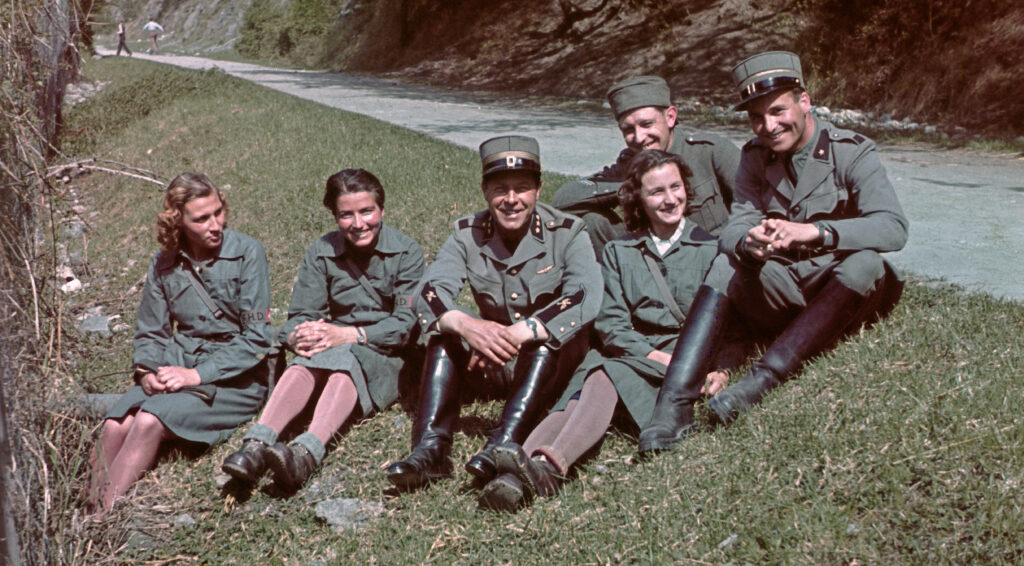
The role of women in the Swiss Armed Forces has long been debated. Before the Second World War, the so-called Women’s Auxiliary Service was established. Women primarily performed duties in kitchens, field postal services, and transportation—tasks that reflected the gender norms of the time.
Civil Protection Duty Before Women’s Suffrage
In 1957, voters were asked to decide on a civil protection law that also provided for compulsory service for women. The proposal was rejected. Women’s organizations argued that such a measure should not even be considered until women were granted the right to participate in political decision-making.
In 1970, the Federal Military Department examined ways of involving women more actively in national defense. Among the proposals discussed was the creation of a female reserve army. Yet the division of roles remained clearly stereotypical: men were expected to fight with weapons, while women were expected to protect, care for others, and fill logistical gaps. These ideas met with resistance from both feminists and conservative voices. Feminists criticized the perpetuation of traditional gender roles, while conservatives maintained that women belonged in the home rather than in the military, which they regarded as a male domain.
Equal Roles Only Since 2004
In 1986, the Women’s Auxiliary Service was transformed into the Women’s Military Service. Women could now attain military ranks but remained unarmed. Mixed-gender recruit schools were introduced only in 1995, and it was not until 2004 that women were allowed to serve in all military functions, including armed positions.
In 2022, under Federal Councilor Viola Amherd, the Office for Women in the Armed Forces and Diversity (FiAD) was established. A study published by FiAD in 2024 confirmed that militarization reinforces existing power structures, including patriarchal violence and gender inequality. While gender-based violence is already widespread throughout society, the study found that it is experienced even more frequently within the military, particularly by women and queer individuals. Although respondents reported different experiences of discrimination, they all identified the military’s internal culture as the primary cause of such discrimination.
Fundamental Contradictions
While the integration of women is often presented as progress and a step toward equality, the military institution remains closely linked to patriarchal structures, violence, and inequality. From a peace-policy perspective, it is also questionable whether expanding the military actually leads to greater security and peace.
Moreover, women already make a substantial contribution to society without performing military service. According to the Federal Statistical Office, women devoted approximately 36 hours per week to unpaid care work in 2024. The annual value of this work is estimated at 322 billion Swiss francs. Genuine equality, therefore, depends on recognizing and valuing this unpaid labor rather than requiring women to perform military service.