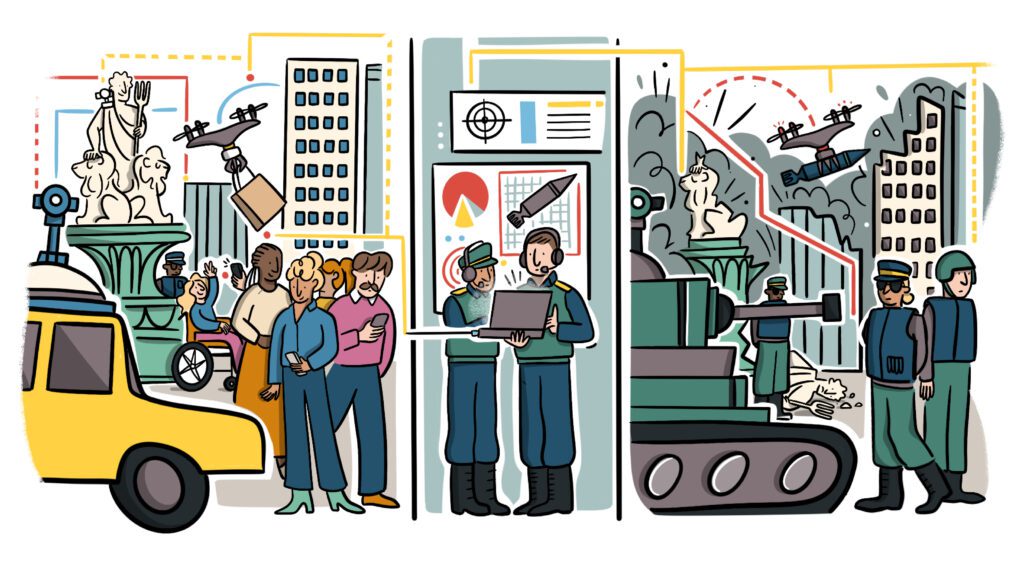
A global tech race, driven by rapidly expanding public and private investment, is reshaping the boundaries between civilian and military spheres. This phenomenon undermines the conditions that make effective peacebuilding work possible. Privacy International’s Challenging Militarization of Tech project examines how the same data-intensive systems – including surveillance tools, cloud infrastructure, and others – are increasingly being deployed across both civilian and military domains. What follows is the loss of transparency and oversight, creating significant implications for human rights and accountability. This is not an abstract technical problem: it affects whether a mediator can be trusted in a conflict zone, whether a local NGO can protect its sources, and whether funds are directed toward conflict prevention or military applications.
Recent examples illustrate this trend. Corsight AI developed facial recognition systems that were initially tested in war zones before being marketed for civilian surveillance. Palantir, a data analytics defense contractor, has partnered with the World Food Program to support humanitarian aid delivery and with the UK’s National Health Service to centralize patient data. At the same time, its systems have been used to support military operations in Gaza. More broadly, many AI tools used in warfare are architecturally indistinguishable from those being adopted by governments to manage public services. They are mostly built by the same companies, on the same data infrastructure, and funded by the same investors.
For civil society organizations, peacebuilders, and the communities they serve, these developments carry significant risks. In 2018, research conducted by Privacy International and the ICRC showed that humanitarian organizations’ use of digital tools can generate data trails that may be accessed or exploited by third parties, potentially putting aid recipients at risk. This growing convergence of military, humanitarian, and commercial technologies also affects the trust and neutrality on which peacebuilding work depends. When people cannot distinguish who is collecting their data — whether a military actor, a peacebuilding or humanitarian organization, or a commercial platform serving both — the essential trust in mediators and peacebuilders becomes weakened.
Overall, these trends concentrate power, reduce oversight, and increase the risk of misuse. This is the opposite of what people-centered security requires. Addressing these challenges requires coordinated action: humanitarian, development, and peacebuilding actors, alongside civil society, security, and affected communities, should build coalitions, demand transparency and accountability in the governance of data-intensive systems. It is also essential to make clear to policymakers that rights-based approaches to security are not optional, but the foundation of durable peace.