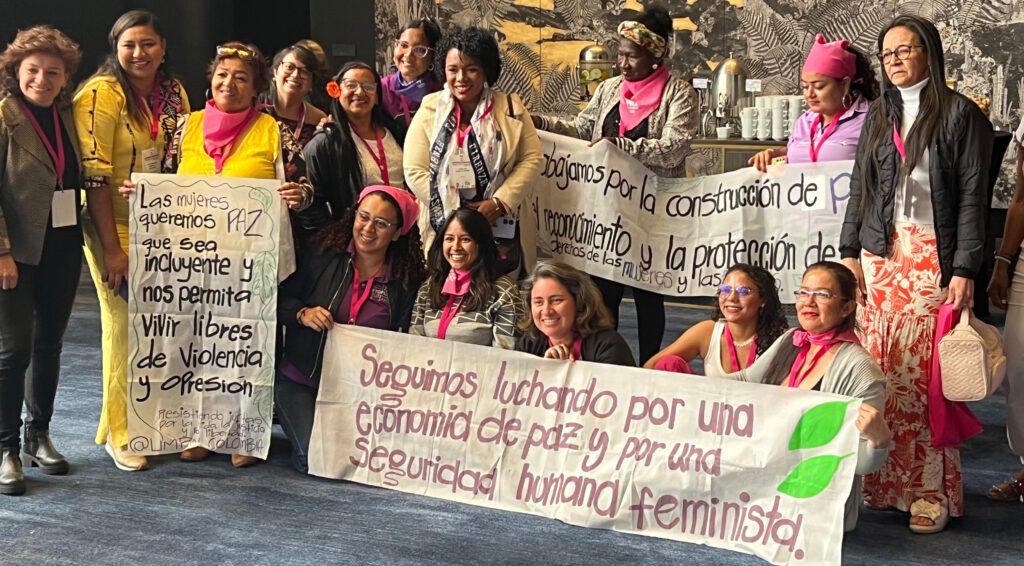
Struggles for women’s rights and feminist advocacy for peace have coexisted since the beginning of the 20th century. However, it was only with the adoption of UN Security Council Resolution 1325 in 2000 and its nine successive resolutions, that international law began to shape the Women, Peace and Security Agenda (WPS Agenda) and recognized its centrality in peace negotiations, conflict resolution, and addressing security issues.
The experience of localizing Resolution 1325 through National Action Plans and the progressive materialization of this agenda has varied, offering lessons learned that defy the scope of its initial promulgation. In Colombia, the broad women and peace movements have successfully driven political, legal, and transitional justice transformations for over 30 years to enable a negotiated solution to the armed conflict—despite the absence of a National Action Plan.
Over the past two decades, Colombia has signed peace agreements with two armed groups, established transitional justice processes, and recognized victims’ rights. Still, criminality persists, and peace has not yet been achieved. To tackle ongoing violence, the government is promoting several dialogues and negotiations with various armed actors simultaneously.
Colombia’s women and peace movement is broad and diverse, comprising strong organizations, networks, and leadership at both national and local levels. On several occasions, the women’s movement has supported, promoted, and monitored peace processes, pushed for victim reparations, and demanded the structural transformations foreseen in the peace agreements. This is how the alliances between peacebuilders, the State, the international community, and the negotiating parties in the peace processes have brought life to and embodied the WPS Agenda for Colombia.
In the 1990s, following the 1991 Constitution, Colombian women obtained the recognition of their right to equality after defending their communities from armed actors and organizing feminist marches for peace and non-violence. In the 2000s, they documented and litigated the differential affectations and disproportionate impacts of the war on women, ultimately leading to the adoption of constitutional protection for the rights of women and girls who were victims of forced displacement.
Significant progress has been made since 2011 regarding reparations for women victims and the recognition of the connection between patriarchal violence in everyday life and its exacerbation during the conflict. With this experience and a strengthened movement, women have been able to participate in and influence the peace processes and the incorporation of the WPS Agenda in the agreement between the government and the FARC-EP (Fuerzas Armadas Revolucionarias de Colombia – Ejército del Pueblo), the most powerful armed group. Today, women peacebuilders continue to address the humanitarian crisis, monitor the implementation of the peace agreement, and strive to participate in ongoing negotiations.
The current government’s election in 2022 brought renewed hope that Resolution 1325 would move beyond an advocacy instrument and become a state policy. Close to 24 years after the first adoption of the WPS Agenda, Colombia is on the verge of implementing its first National Action Plan for Resolution 1325 (NAP 1325), with a planned launch by the end of 2024. The NAP 1325 includes innovative elements designed to broaden the agenda’s scope of action to address contemporary peace and security challenges faced by women. Over 1,500 women from all over the country participated in the initial drafting phase. Unlike other NAPs that focus on foreign policy, Colombia’s plan centers on domestic policy. In addition, it adopts an intersectional approach to recognize women’s diversity and holds 33 institutions responsible for its implementation and funding over the next 10 years. The plan prioritizes issues such as migration, economic autonomy, sexual and reproductive violence, the environmental crisis caused by extractive industries, the safeguarding of territory, indigenous and afro-descendant peoples and their ancestral knowledge, and discussions on feminist security and mental health, among others.
Meanwhile, Switzerland is drafting its 5th NAP 1325. PeaceWomen Across the Globe, together with Frieda – the feminist peace organisation and KOFF/swisspeace, were responsible for the report containing civil society’s priorities and recommendations. Colombia’s example highlights the importance of including diverse women’s organizations for both the elaboration and implementation of the NAP. They are the ones who fought for peace and security, with or without a NAP. Their experiences are key to positioning the above-named issues that impact women’s security. It is essential to address contemporary security challenges from a gender perspective. This means moving away from traditional state-centered security concepts towards feminist and people-centered security principles.
Colombia, like other countries such as Canada and Germany, has understood that the impact of NAPs requires effective collaboration between women’s organizations, domestic policy, foreign policy and all state institutions. Taking up the challenges of this process means that Switzerland must debate what it means to fully commit to the WPS Agenda. It is not plausible to position the WPS Agenda in foreign policy and not take appropriate measures domestically. Switzerland may not face an armed conflict like Colombia, but, as in Colombia, women’s organizations understand that the WPS Agenda is about preventing war, not making it safer for women. Our expertise and experience position us as key actors, both in shaping and implementing the WPS Agenda.