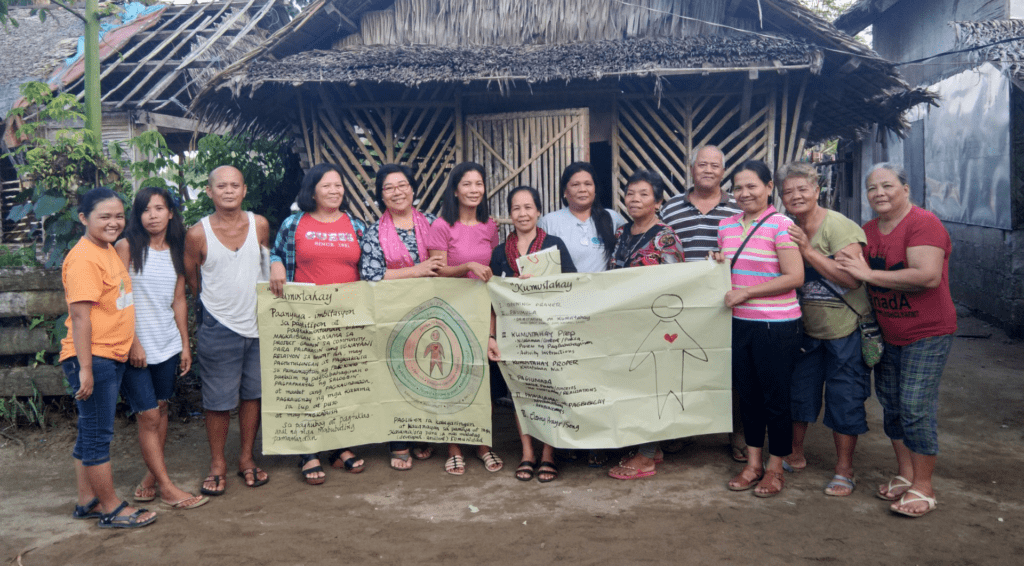
Every year, the Philippines are hit by typhoons that are becoming increasingly violent and frequent. The destruction is so extensive that Fastenaktion’s development projects targeting farmers and fishing communities are severely affected. As a result, harvests and fishers’ boats have been destroyed, alongside the vital energy needed to keep working. In response to this, Fastenaktion and their partner organization CERD have provided food, seeds, and psychosocial support since 2014. To this end, they have used various psychosocial support tools that are now an integral part of Disaster Risk Reduction training. The sharing space, kumustahay (how are you? in tagalog) is one of them: during a regular dedicated time, typhoon survivors share their emotions, despair, or feelings of loneliness.
Through this space, the participants can lighten the weight of their suffering. The authenticity of the exchange strengthens the bonds within the community, as one survivor testifies: “Sharing made me feel stronger and confident to go on, now knowing there are others like me in the same situation.” Sally, CERD’s director explains that survivors tend to increase their social interactions after having participated in this space. This sharing space is not only a lever for the community but also for the partner’s team, whose members are affected by the typhoons too. It contributes to social cohesion, a greater sense of community, solidarity and trust. The individual and collective resilience that emerges through this process strengthens the team’s engagement in the project.
The phenomenon of typhoons in the Philippines shows the interlinkages of the humanitarian, development, and peacebuilding areas, and the added value of integrating psychosocial assistance in the nexus. The scale of the losses incurred by typhoons exacerbates poverty, which provides fertile ground for conflict. CERD observed that the social skills acquired during psychosocial processes, such as the sharing spaces help develop empathy and solidarity among their members, and strengthen their ability to deescalate tensions and chaos. Marcos Diaz, a survivor of several typhoons and leader of a small fisher organization said that the psychosocial assistance provided by the shared spaces encouraged him to resolve conflicts among the villagers, brought on by the unfair allocation of relief aid. He was able to transform the course of the conflict and motivated the survivors to call on the government to provide relief assistance in a more efficient, transparent and fair manner.
CERD now uses sharing spaces throughout the year, not only after typhoons. The psychosocial culture that has been built up in this way is a valuable contribution to sustainable peacebuilding. Within Fastenaktion’s Philippines program, psychosocial support is an essential pillar of emergency aid, project reconstruction and community cohesion.