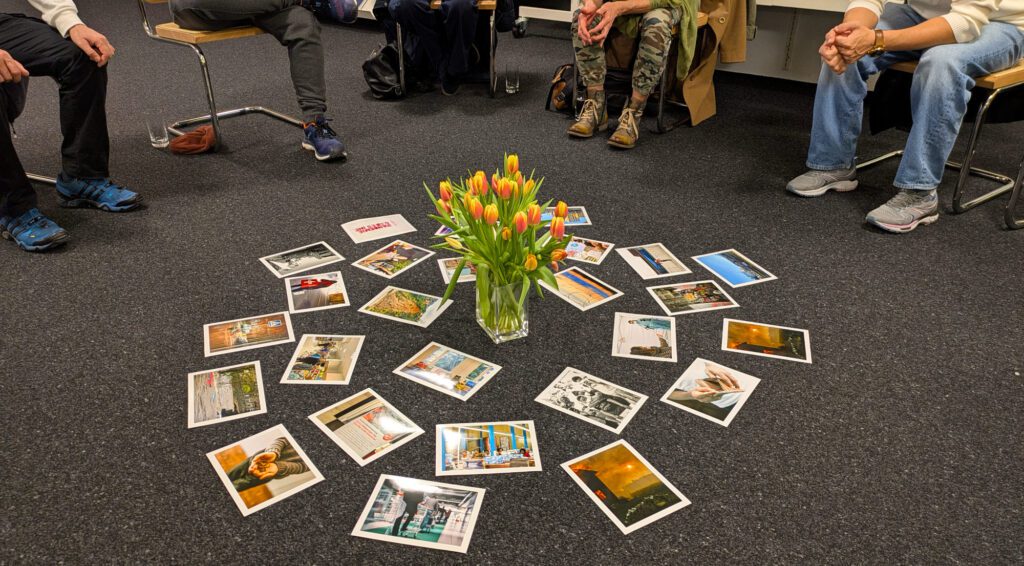
Societal crises can undermine trust in institutions, deepen social divisions and conflicts, and foster feelings of powerlessness. Yet they also create opportunities for new forms of togetherness. With this assumption, the Lucerne-based association Zwischentöne – Lernen aus Krisen initiated a biographical and participatory process: around 70 people shared and documented their personal experiences of societal crises such as the coronavirus pandemic, climate change, discrimination, and violence. The aim was especially to give visibility to the voices of those seldom heard, such as refugees, people affected by poverty, young people, and persons with disabilities. It consisted in experimenting the “politics of being heard” as a resource for societal resilience.
Biographical approach and participation
In international peacebuilding, life storytelling is regarded as a resource for creating meaning, fostering empathy, and processing traumatic experiences both individually and collectively. It can build bridges between different groups and open new spaces for communication. Participatory approaches, meanwhile, encourage personal responsibility, resilience, and agency. Zwischentöne combines these two dimensions and thus creates resonance spaces that connect individual experiences with sociopolitical dynamics.
Five key insights
- Valuing experiences. In crises, the loudest voices often dominate; nuanced perspectives, especially those from marginalized groups, are rarely heard. Zwischentöne documented these voices and made them publicly accessible. As Jahn Graf, head of inclusion at Kleintheater Luzern, activist, moderator, and podcaster, puts it: “There is this well-known saying: The strength of a society is measured by how it treats its minorities. I would add: … in times of crisis. In normal times, we are not welcome, but tolerated. In crises, we are nobody. Before the next major crisis, we must learn that only a diverse society is strong. We must all be at the big table to present solutions.”
- Need to be understood. Many storytellers reported repeated experiences of not being heard. This invisibility weakens trust in democracy and leads to withdrawal. Low-threshold dialogue formats can create resonance when sincere empathy, openness, and genuine interest in others are present. As Somi explains: “Many Swiss people think: refugees come here, they get money, they get everything, and they do nothing. But that’s not true. We are always trying everything: How can we integrate? How can we find a good job?”
- Reaching people in their life worlds. Participatory processes are only effective when they take place in familiar settings. Libraries, parishes, or refugee meeting points proved to be key. Young people, however, remained difficult to reach. In retrospect, this was likely due not only to communication, but also to the absence of young people in project leadership – individuals who could have acted as credible bridges.
- Linking experience and politics. Addressing crises requires mutual openness: politics should become more visibly human and vulnerable, while citizens must take responsibility for co-shaping. Our own encounters with members of parliament showed that dialogue on an equal footing is possible.
- Building alliances across forms of discrimination. Zwischentöne brought together voices from different marginalized groups. Making overlapping experiences visible opened new opportunities for building solidarity-based alliances.
Outlook
Biographical storytelling spaces should be systematically integrated into crisis and dialogue strategies in Switzerland. They are tools for crisis and conflict processing and contribute to social cohesion. As a next step, Zwischentöne, together with public authorities, is developing a prototype for participatory crisis management at the municipal and cantonal levels.