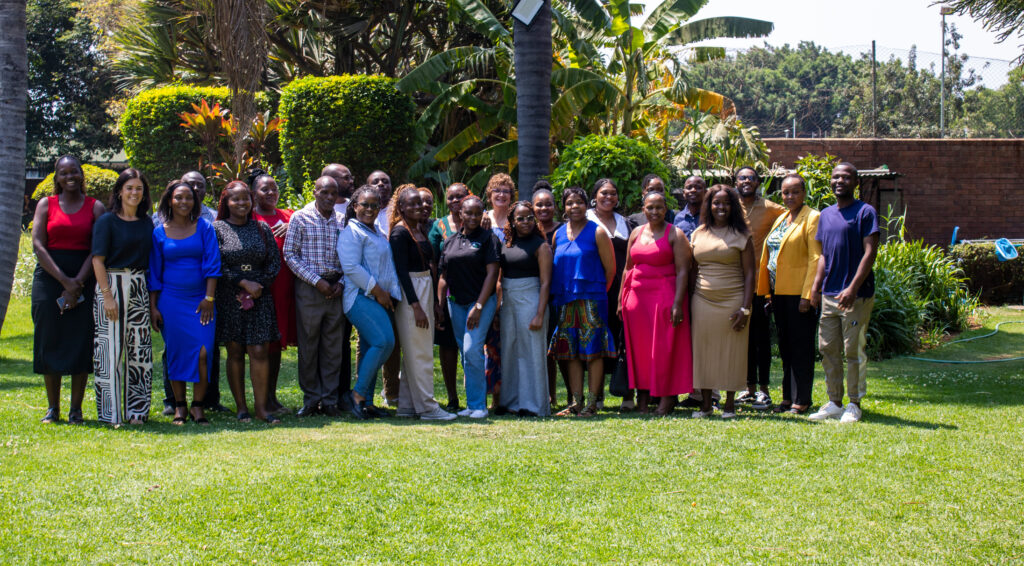
For terre des hommes schweiz (tdhs), localization represents a power shift. Responsibility and decision-making authority are consistently transferred to the locations where programs are implemented. The co-program coordination and co-thematic responsibility exemplify how this principle is applied in practice.
Since early 2023, terre des hommes schweiz has shifted away from its traditional centralized structure for programs implemented in Africa, where both program coordination and thematic responsibility were exclusively managed from Basel. Both roles are now shared between a person in Switzerland and a colleague in Zimbabwe. This approach aligns decision-making processes more closely with local contexts and fosters shared responsibility. Local expertise is directly integrated, avoiding reliance on hierarchical North-South decision-making.
Shared responsibility enables a division of labor based on spatial and institutional needs. The Switzerland-based individual handles tasks such as networking, liaising with donors like the Swiss Agency for Development and Cooperation (SDC), and coordinating with Swiss funders. Meanwhile, the Zimbabwe-based individual brings proximity to projects, partner organizations, and local networks, conducts more frequent project visits, and possesses a deeper understanding of local conditions. Decisions can thus be made in a more contextually relevant manner without losing institutional ties to international administration.
The experiences gathered with co-responsibility have been predominantly positive. Instead of seeking approval, decisions are now more informed by local teams, making processes leaner and more efficient. Incorporating expertise from program countries also enables co-decision-making and co-shaping at the strategic level, although this comes with a linguistic challenge: English has become the primary working language for the team based in Basel as well. The language aspect must be considered if co-responsibility is extended to non-English-speaking regions.
Given the overall positive outcomes, the co-responsibility model is currently being applied to terre des hommes’ work in Colombia. This marks another step toward a stronger power shift in terre des hommes Schweiz’s approach.