On 9 November 2025, Mexican President Claudia Sheinbaum launched the Michoacán Plan for Peace and Justice, deploying 12,500 military personnel and allocating 57 billion pesos (approximately CHF 2.5 billion). Its objective was to restore security in a state severely affected by organized crime-related violence. Yet the plan failed to include any specific protection measures for human rights defenders, Indigenous communities, and journalists, even though they are among those most exposed to such violence.
From the moment the Plan was announced, the Supreme Indigenous Council of Michoacán denounced it as a “discriminatory, unilateral, and misleading” initiative developed without consultation with Indigenous peoples. Six months after its launch, an analysis based on official data showed an increase in crime in more than half of Michoacán’s municipalities. On 5 May 2026, renewed clashes between criminal groups in Apatzingán forced 668 people to flee their homes. According to Julio Franco of the Apatzingán Human Security Observatory, “the increased deployment of security forces only consolidates militarization, without strengthening the authority of the Mexican state or the rule of law in these territories.” The Purépecha communities of Acachuén reached a similar conclusion, describing the Plan as a “complete failure.”
In this context, Espacio OSC—a national platform bringing together organizations defending human rights and press freedom, and accompanied by PBI Mexico for more than ten years—called for the Plan to recognize human rights defenders and journalists as groups with specific protection needs. This demand is particularly significant in Michoacán, which currently has 158 beneficiaries of the Federal Protection Mechanism, making it the third most affected state in the country. Yet the Plan makes no mention of them.
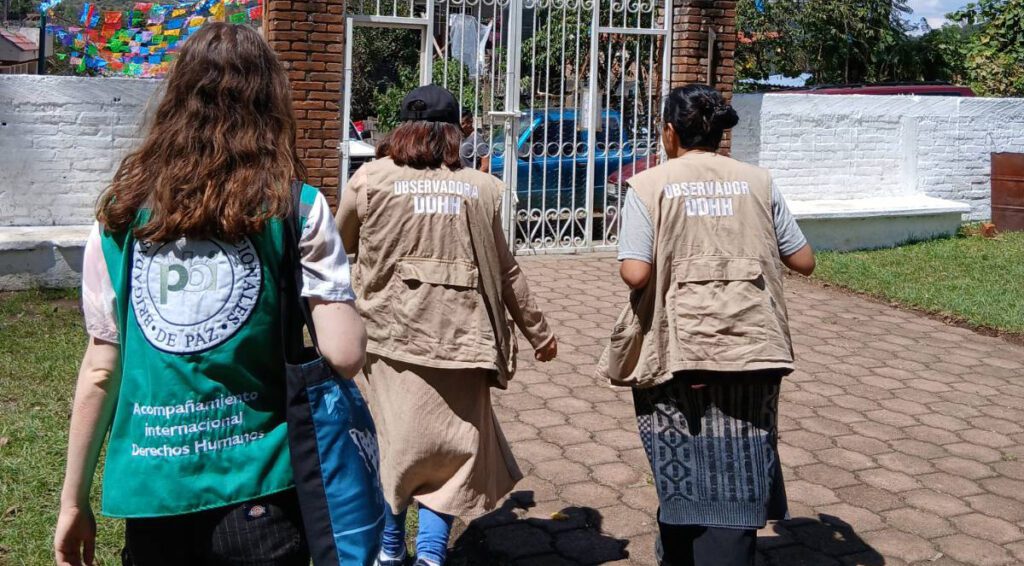
On the ground, PBI accompanies the Michoacán Human Rights Solidarity Network (Red Solidaria de Derechos Humanos de Michoacán), of which Purépecha defender Claudia Ignacio Álvarez is a member. In December 2025, as part of a PBI advocacy tour, she traveled to the United Kingdom to meet British parliamentarians and the Minister for Human Rights. Speaking about the risks faced by Indigenous defenders, she stated: “Purépecha women are beaten when they speak out. The police arrive in riot gear to intimidate me, to prevent me from speaking or taking action. We are followed everywhere. Heavily armed police officers are stationed outside our homes and keep us under surveillance. The police have even threatened to kill me.”
The experience of Michoacán illustrates the limitations of approaches that rely primarily on military deployment to restore peace. For human rights defenders, journalists, and Indigenous communities, security also depends on the protection of rights, access to justice, and the preservation of an open civic space. In this context, PBI’s work is more relevant than ever: supporting civil society actors by strengthening their visibility and solidarity networks, enabling them to continue their work despite the risks posed by increasing militarization.