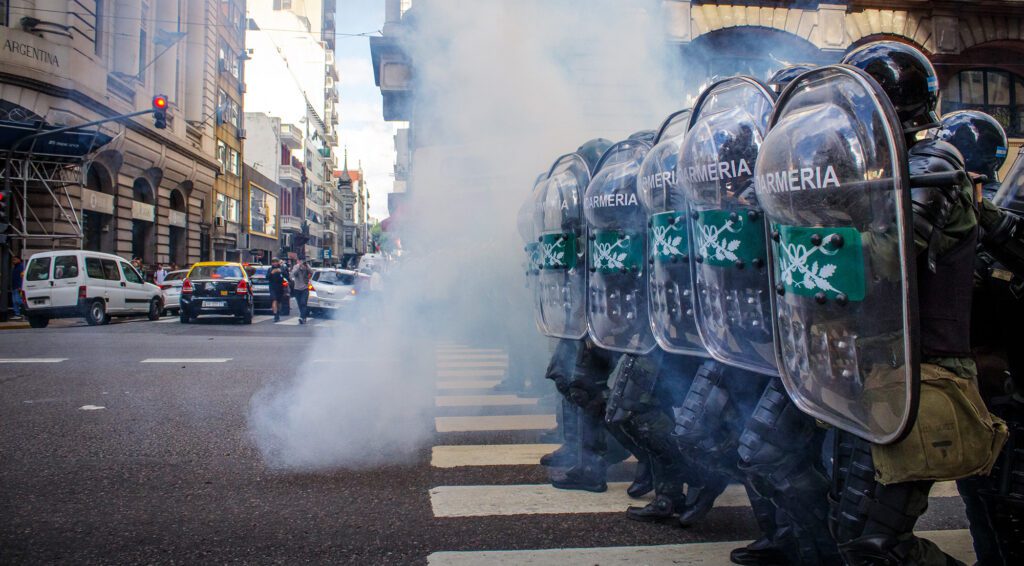
In Argentina, the signs of authoritarian drift under President Javier Milei did not begin at the ballot box; they were the outcome of accumulated economic, social, and political crises that left society exhausted. Seen as an outsider vis-à-vis an ineffective political class, Milei capitalized on annual inflation of 211.4% in 2023 and a poverty rate of nearly 40%.
Rising Threats to Freedom of Speech and Civil Society
Since late 2023, a national measure known as the “Anti-Picket Protocol” has strengthened the police response to road blockades and protests. As of June 30, 2025, at least 2,467 people had been injured at protests, according to the Provincial Commission for Memory (a local human rights organization). Press freedom has also declined, putting journalists, activists, and advocacy organizations like Amnesty International at greater risk. Stigmatization, attacks, abusive lawsuits, and the excessive use of force have made access to independent information increasingly difficult.
Strategic Risk Assessments and Public Engagement
To sustain pluralism and human rights initiatives in this challenging environment, Amnesty International works along three pillars:
• Digital listening to understand social moods;
• documentation of human rights violations with rigorous standards and protocols;
• “pincer” advocacy that combines local work with international pressure.
The organization has adjusted practices to reduce risk: it prioritizes collective testimonies (as individual testimonial givers face higher exposure), minimizes the collection of sensitive data (avoiding real names, surnames, addresses, or any other information that could enable targeting or revictimization), and relies on cultural and digital formats that audiences already engage with.
Clear Rules for Engagement and Protection
Amnesty’s engagement with the Argentinian State follows well-defined rules: technical dialogue, traceable commitments, and, when doors close, escalation to oversight bodies. To protect teams and communities, security protocols are applied (contingency plans, safe routes, and rotating spokespeople). Before each intervention, whether a march or a human-rights campaign, political and social context analyses are conducted, including public-opinion studies and social listening, and mapping of key actors and tension indicators. Decisions rely on a basic checklist: is it legal, is it necessary, and is it proportionate?, backed by risk assessments and the essential “do no harm” principle.
In this environment, Amnesty International remains committed to documenting abuses and sustaining human rights advocacy while minimizing risks to communities it works with. Grounded in rigorous context analysis and strict security protocols, its work continues to support litigation and public campaigns without exposing teams or partners. This approach ensures interventions that are both responsible and effective, even as Argentina’s space continues to shrink.