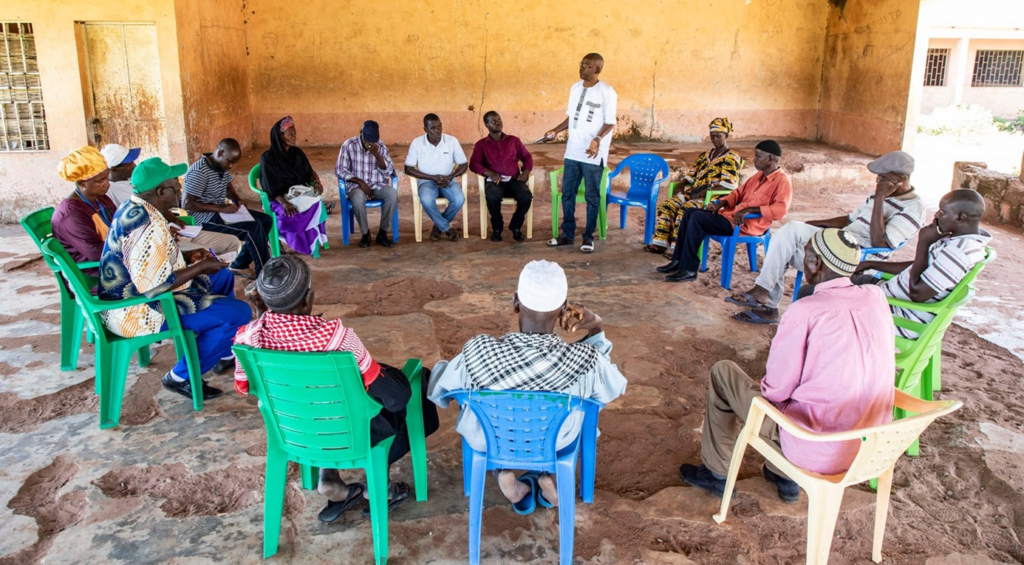
The discourse around the humanitarian-development-peace (HDP) nexus is no longer just a conceptual ambition. It now reflects a systemic shift in how aid is planned, coordinated, and delivered. Grounded in global commitments like the 2023 New Agenda for Peace and the 2024 Pact for the Future, it urges international actors to integrate risk mitigation, conflict resolution, and social cohesion into development and humanitarian efforts. At the operational level, this means transforming how aid is delivered. Interpeace, in collaboration with FAO, UNFPA, and UN-Habitat, is advancing this approach in Guinea-Bissau.
In the Bafatá and Gabú regions, a flagship sustainable development initiative integrates peace responsiveness by addressing land and water disputes and tackling broader social inequality issues. In these regions, traditional transhumance practices – the seasonal migration of people and their livestock between different grazing areas – have been severely disrupted in recent years due to the rapid expansion of agricultural land, especially for cashew nut plantations. This shift has fueled conflicts between farmers and pastoralists, who are communities that continue to be marginalized and deprived of essential services such as healthcare and access to justice. These tensions frequently escalate into violence, with incidents of poisoned livestock, stolen cattle, and farmland set ablaze, turning resource-based disputes into deeper social conflicts.
To address these challenges, the initiative integrates development with peacebuilding by amplifying local voices and promoting inclusive dialogue; such as through farmers’ dialogue clubs and women’s spaces. This approach informs national legislation on transhumance and land use with concrete policy recommendations. By strengthening local mediation capacities, the initiative supports the identification and implementation of community-driven solutions and preventive measures for water and land-related conflicts. It also addresses root causes of conflict by reducing exclusion, enhancing access to healthcare1 and essential infrastructure2 for both people and livestock in vulnerable communities, and fostering social cohesion.
Partnerships with national ministries and local institutions have been pivotal, especially in enhancing the presence of state institutions in underserved areas. Tailored capacity strengthening helped support Herders’ Associations, expand Sector Land Commissions, and equip government departments with tools to manage geography and land planning. A key prerequisite for integrating the peace responsiveness approach into this project was the openness of both partners and donors to the value of embedding the HDP nexus within the initiative. This underscores that peace responsiveness is a system-wide approach, one that must be embedded both within and across organizations to achieve meaningful, collective impact. Funded by the UN Peacebuilding Fund, the initiative runs through 2025. It offers a scalable model for integrating peace responsiveness into sustainable development by placing communities at the heart of solutions.
[1] Health services provided included two mobile clinics serving remote areas, an animal vaccination campaign, and awareness campaigns on reproductive health and HIV/AIDS prevention.
[2] Infrastructure support included the construction of boreholes, watering points for livestock, and the opening of transhumance corridors.