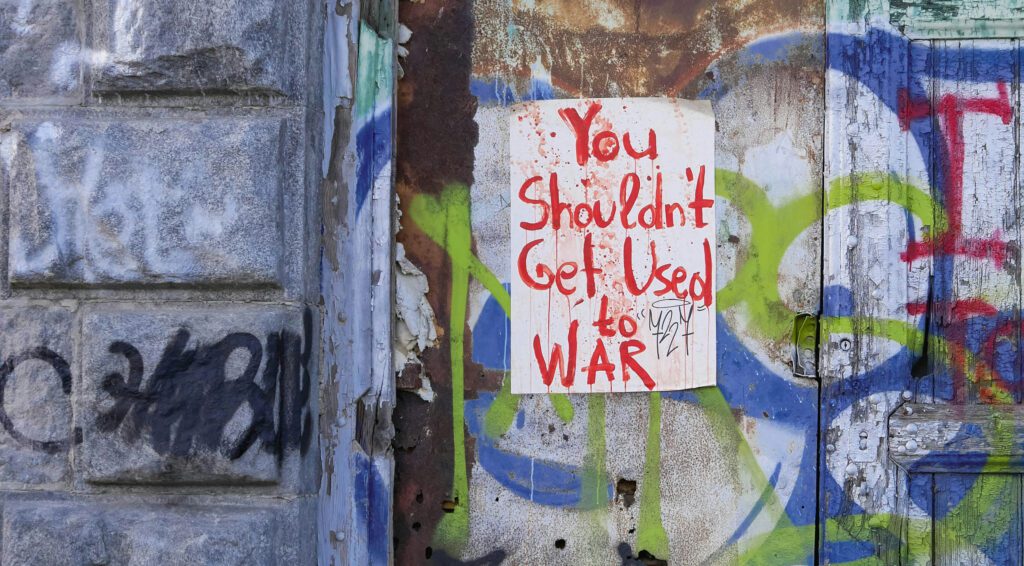
State of the world
States are largely the ones waging war; they have armies and arms, and they have the means needed to supervise arms’ production. War and war means are waged and used mostly by men to the exception of conscientious objectors, similar “refuseniks” and those not drafted. War is rather recent in history, between 15’000 and 7’000 years for the most recent archeology discoveries. War is illegal through the United Nations’ Charter since 1945. The Charter makes peaceful settlement of disputes mandatory and forbids the use of force and threat, with the exceptions of (undefined) self-defense and use of force to restore or maintain peace. Armies can be divided by the number of troops engaged or by budget into roughly three categories of equal size: 1) Army less and micro-armies’ nations (less than 10’000 members of the armed forces). 2) Middle-sized armies (< 200’000 members). 3) Big armies, with the top 10 having more than a million members incorporated.
Why is non-militarization important?
The existence of non-armed nations and other peace-prone states such as Costa Rica proves that war is not built into the sociopolitical fabric of the Nation-State. There are alternatives to the possibility and means of war, and thus ways to walk the path of peace and leave behind the scourge of war, drawing from these examples’ better alternatives to deterrence and use of force.
After making the inventory of possible army-less countries, setting fair criterion to identify them, describing their legal non-militarized backgrounds and their security forces, APRED has moved towards identifying and designing overall peace policies, as they are now used by the United Nations’ peacebuilding Commission and as all States are encouraged to use or create by the 2025 UN Pact for the Future. APRED is inciting, through the Universal Periodic Review of the human rights of all States, countries with small armies to turn these into police and civil protection forces; protection forces which will be ever more needed under the strife’s of climate change. Mauritius has always kept all its security forces within the police and Vanuatu has reintegrated these forces into the police. Nonmilitarisation should also be examined through a gender lens, as research suggests that women experience higher levels of security in army-less countries.
The study of nonmilitarization also shows that nearly all of these countries rank very high in democracy indices.